Watches · In Depth
The Rolex GMT-Master II: The Ultimate Tool Watch?
Developed for the pilots of Pan Am, the GMT-Master has become one of the most recognisable watches ever made. Seventy-one years after its introduction, the combination of mechanical ingenuity, durability and everyday usefulness remains remarkably convincing.
The Rolex GMT-Master II is a particularly satisfying example of a mechanical watch whose complications have a clear practical purpose. It displays the date and a second time zone, allows local time to be changed without interrupting its timekeeping and, with a simple adjustment of the bezel, can indicate a third. Its distinctive appearance has changed remarkably little since the original GMT-Master was introduced in 1955, although the engineering beneath the dial has undergone considerable development.
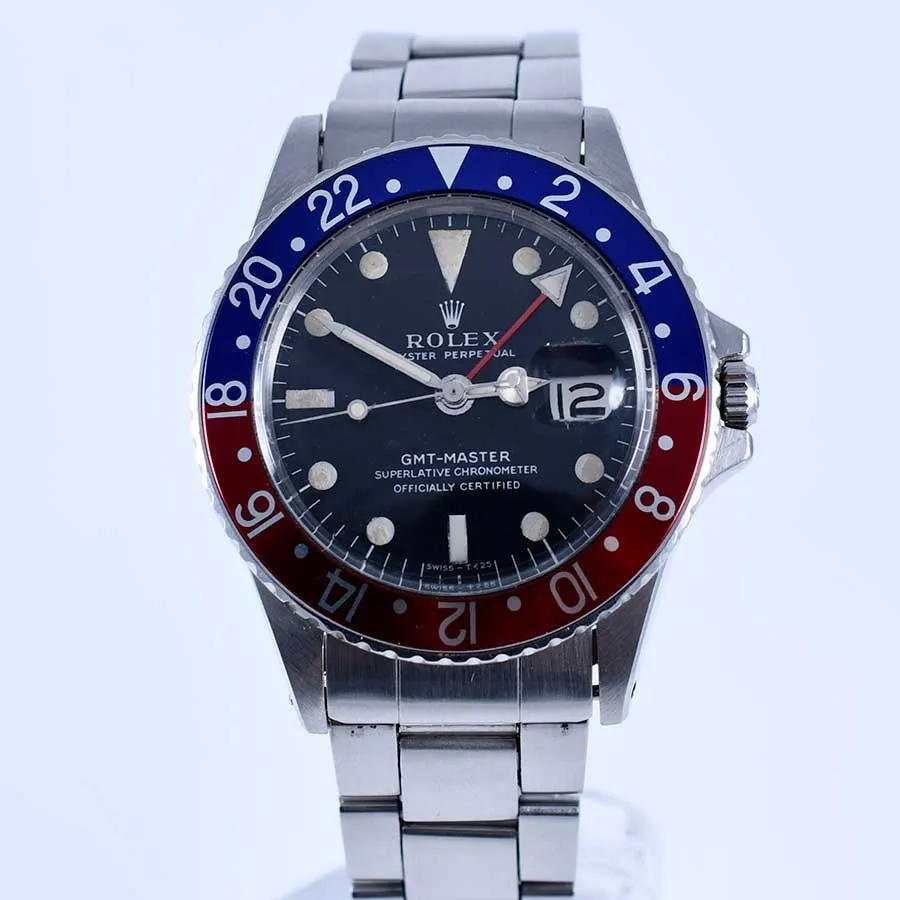
The story begins in the golden age of international aviation. Long-distance commercial flights were becoming increasingly important, and pilots needed to keep track of Greenwich Mean Time alongside the local time at their destinations. Rolex developed the GMT-Master in association with Pan American World Airways, introducing reference 6542 in 1955.

The solution was elegant. An additional hand completed one revolution every 24 hours, while a rotating bezel provided a corresponding scale. The bezel was divided into red and blue sections to distinguish daytime and nighttime hours. Combined with the conventional hands, the arrangement allowed the wearer to consult two time zones without the need for a separate instrument.
It was also a handsome design, with a character quite unlike that of the more restrained dress watches of the period. The broad hands, prominent hour markers and colourful bezel gave the GMT-Master a distinctly purposeful appearance. Much of that original design survives today.
The earliest reference 6542 used a bezel insert made from Bakelite, a synthetic resin, which was subsequently replaced by aluminium. Crown guards appeared with the later reference 1675, and successive generations brought improvements to the movement, case construction and bracelet. The most significant mechanical development, however, arrived in 1982.
Two approaches to GMT
The original GMT-Master’s conventional hour hand and additional 24-hour hand were mechanically linked. The second time zone was selected by rotating the bezel, which shifted the scale against which the additional hand was read.
The GMT-Master II introduced an independently adjustable conventional hour hand. It could be moved forward or backward in one-hour increments without stopping the movement or disturbing the minute, seconds or 24-hour hands.
This distinction is the basis of two familiar arrangements found in modern GMT watches. In a caller GMT, the additional 24-hour hand can be adjusted independently, making it convenient to consult the time elsewhere while remaining in one location. A traveller GMT, such as the GMT-Master II, allows the conventional hour hand to be adjusted independently instead. The original GMT-Master predates both arrangements.
The traveller mechanism is particularly well suited to the watch’s original purpose. On arriving in another time zone, the wearer adjusts the conventional hour hand to local time, while the 24-hour hand continues to indicate home time. The date follows the local hour hand, including when the adjustment crosses midnight. Rotating the bezel provides access to a third time zone, although the 24-hour hand is then read against the repositioned scale.
The mechanism has a couple of limitations. Its independent hour adjustments work in whole-hour increments, whereas some time zones differ by 30 or 45 minutes. And because the local hour hand also controls the date, correcting a substantially incorrect date can require rather more crown turning than with a conventional quickset mechanism.
The independently adjustable hour hand is nevertheless an excellent example of Rolex’s characteristic approach to development: a useful mechanical improvement introduced without compromising the established design.
Engineering an everyday instrument
The current GMT-Master II uses Rolex’s calibre 3285, an automatic movement introduced in 2018. It incorporates the company’s Chronergy escapement, a blue Parachrom hairspring and Paraflex shock absorbers, along with an efficient winding system and a power reserve of approximately 70 hours.
That reserve is sufficient for a fully wound watch to remain running through a weekend off the wrist. It reflects, among other things, Rolex’s continuing work on the efficiency of the escapement, where improvements in energy transmission can make a substantial difference to the performance of a mechanical movement.
Rolex specifies an accuracy of −2/+2 seconds per day for the completed watch, considerably stricter than the −4/+6 seconds permitted under conventional COSC chronometer certification. The company tests the assembled watch after the independently certified movement has been installed in its case.
The familiar 40mm Oyster case is water-resistant to 100 metres, with a screw-down case back and Triplock winding crown. A sapphire crystal protects the dial, while the Cyclops lens magnifies the date at three o’clock. The Chromalight display provides legibility in low light.
The Oyster and Jubilee bracelets are fitted with Rolex’s Oysterlock safety clasp and Easylink extension, allowing their length to be increased by approximately five millimetres without removing a link. It is a small detail, but a particularly useful one in a watch intended for daily wear.
The rotating bezel is another area in which the GMT-Master has benefited from sustained development. Modern versions use Rolex’s Cerachrom ceramic insert, which offers considerably greater resistance to scratching and ultraviolet fading than the aluminium inserts used for decades. Ceramic remains vulnerable to sufficiently sharp impacts, but it retains its colour exceptionally well.
Producing a two-colour ceramic bezel presents particular manufacturing challenges. The pigments must survive the firing process while retaining a clearly defined division between the colours, and the numerals and graduations require precise finishing. Rolex’s successful development of these inserts reflects the considerable manufacturing expertise behind an apparently simple component.
The colours of the GMT-Master
Few watches have acquired such an extensive collection of affectionate nicknames. The original red-and-blue Pepsi, introduced in 1955, remains the most recognisable. Its two colours distinguished day from night on the 24-hour scale. Despite the watch’s association with Pan Am, there is no convincing evidence that the colour scheme was chosen to reflect the airline’s predominantly blue-and-white branding.
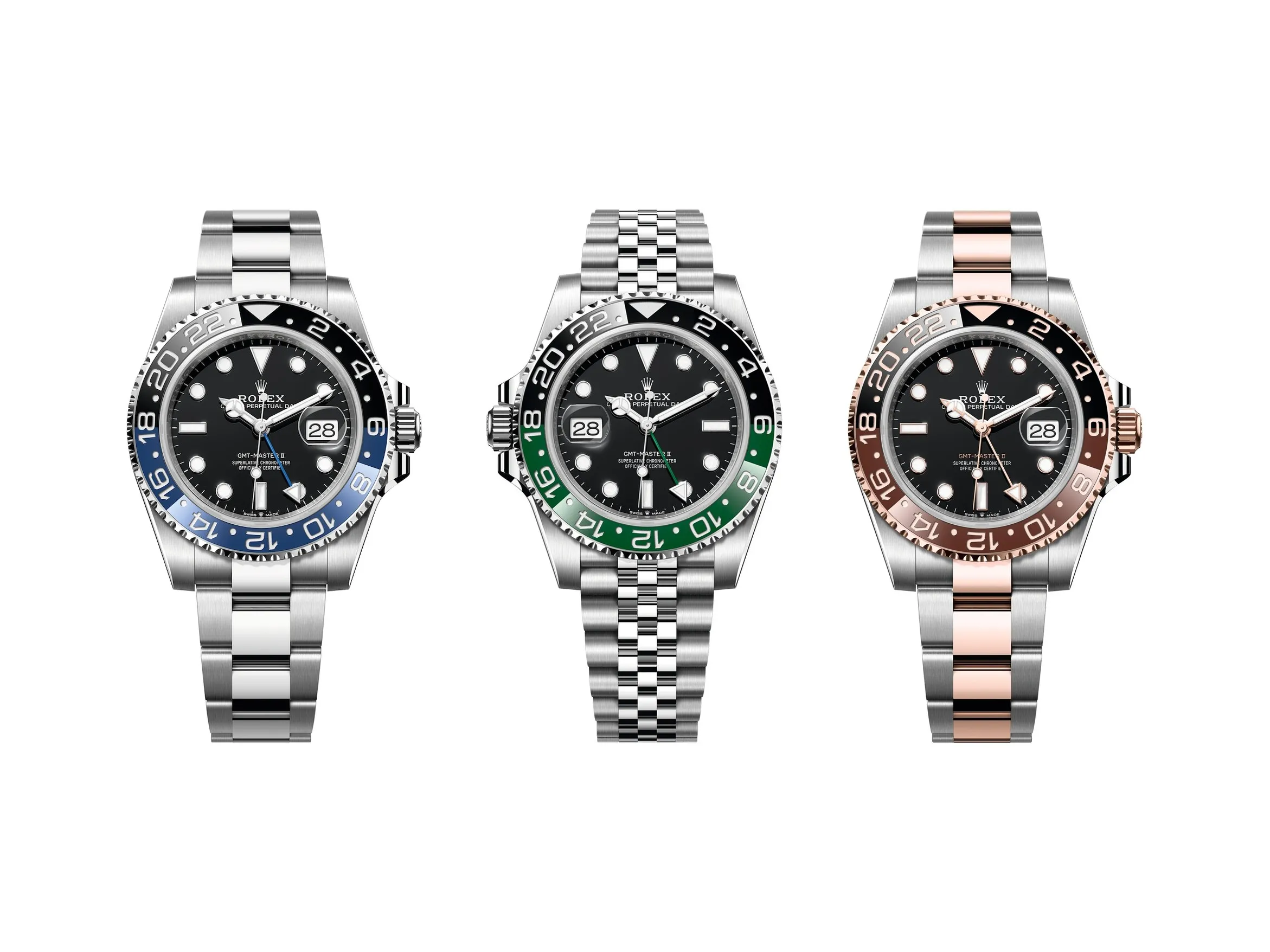
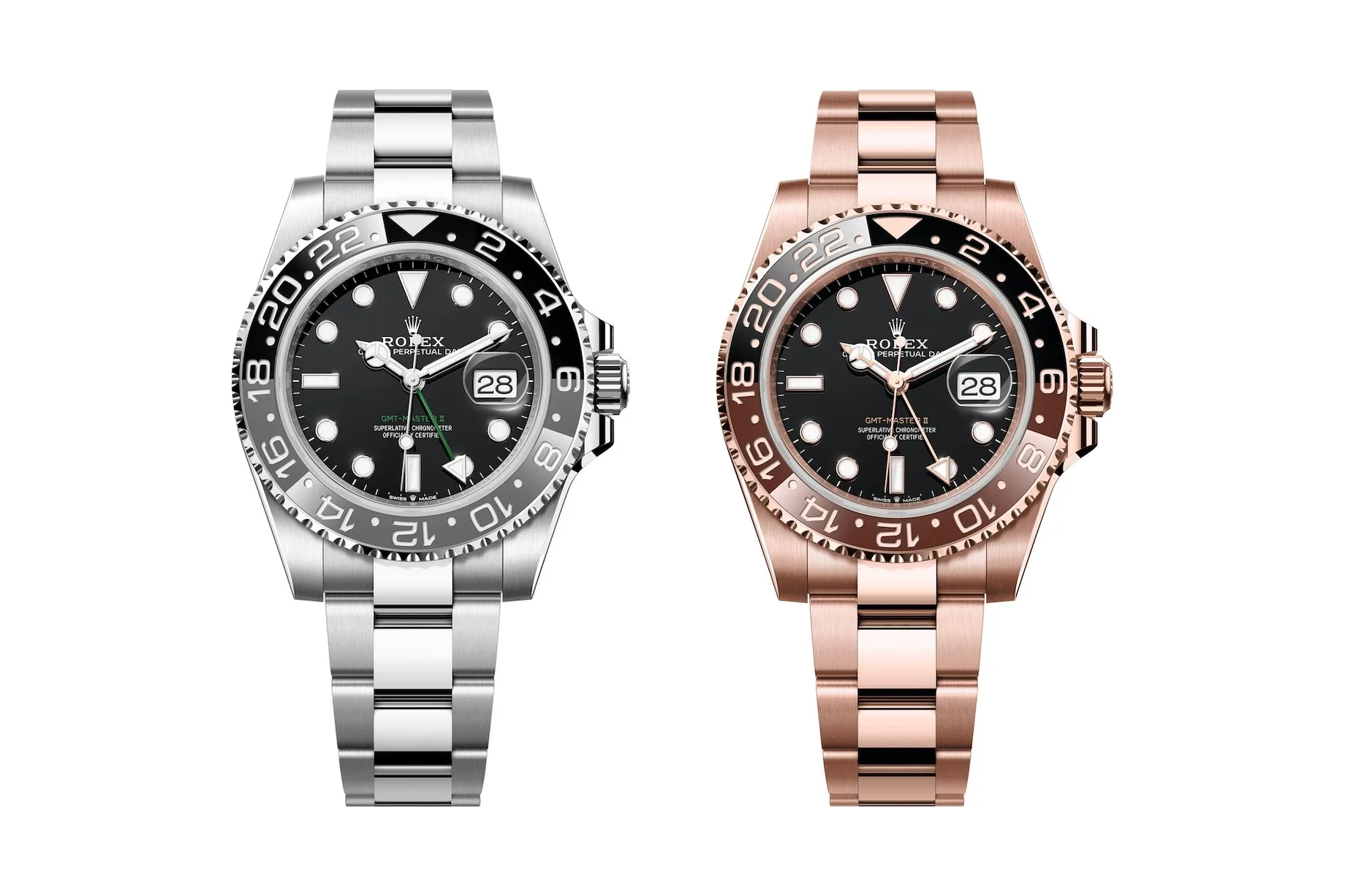
The red-and-black Coke appeared with the GMT-Master II in the early 1980s, while the brown-and-gold Root Beer originated with steel-and-gold models in the 1970s. More recent combinations include the blue-and-black Batman, introduced in 2013; the green-and-black Sprite of 2022, with its left-hand crown and date at nine o’clock; and the more restrained grey-and-black Bruce Wayne, introduced in steel in 2024. The names are informal, but they have become part of the language of Rolex collecting. Rolex removed the steel Pepsi from its catalogue in 2026.
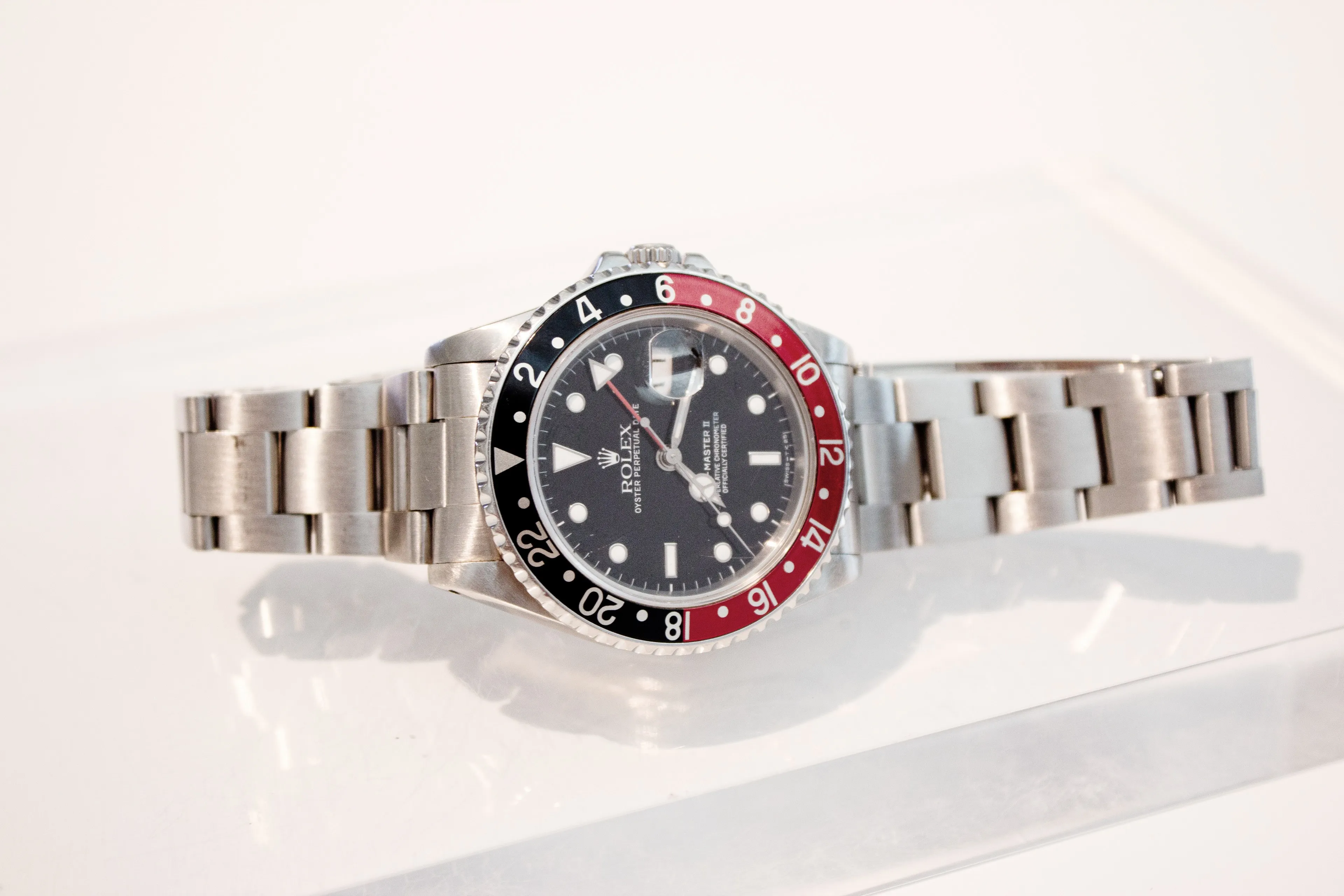
The older aluminium bezels have acquired a particular fascination because their colours can change with age. Exposure to sunlight and ordinary wear sometimes transform the red of a Pepsi bezel into a pale pink, while the blue may fade towards grey or violet. Some examples develop strikingly uneven colours, giving individual watches an appearance quite different from when they left the factory.
This patina has become an important aspect of vintage GMT-Master collecting. What began as the ageing of a functional component can contribute substantially to the character, desirability and market value of a particular watch. The modern ceramic bezels are much more resistant to such changes, trading the possibility of distinctive ageing for greater long-term colour stability.
The variety of bezel colours has also had an unusual effect on the GMT-Master’s identity. The watch remains instantly recognisable across remarkably different combinations of materials and colours, from the original steel Pepsi to the warmer appearance of an Everose-gold Root Beer. Few changes are needed to give the same underlying design a markedly different character.
An enduring design
A contemporary GMT-Master II is a considerably more sophisticated instrument than the reference 6542 introduced in 1955. Its movement is more precise, the independently adjustable hour hand makes travelling easier, and successive improvements to the case, bracelet and materials have increased its robustness and convenience.
Yet the relationship between the earliest examples and the current watch remains unmistakable.
This continuity is one of Rolex’s great strengths. The company has generally preferred to refine its established designs rather than replace them with something entirely different. The GMT-Master illustrates the effectiveness of that approach particularly well. Its appearance was sufficiently resolved from the beginning to accommodate decades of mechanical and manufacturing improvements without losing its identity.
There is considerable aesthetic appeal in that consistency. The proportions, broad hands and distinctive bezel have become familiar, but familiarity has done little to diminish the design. The 24-hour hand adds visual interest without compromising the clarity of the dial, while the various bezel colours have allowed the watch to develop several recognisable personalities within the same basic form.
Its construction also reflects an unusually coherent set of priorities. The movement has been developed for precision, efficiency and resistance to disturbances. The case is robust and water-resistant, the bracelet and clasp are carefully engineered, and the time-zone functions are readily accessible without unnecessarily complicating the watch’s operation.
The GMT-Master II is a valuable object, both in terms of its construction and its position in the market. Its desirability has made certain references difficult to obtain through authorised retailers, and discontinued versions can command substantial premiums. Those circumstances are part of the watch’s commercial history, although its technical qualities can be appreciated independently of them.
What ultimately distinguishes the GMT-Master II is the extent to which its design, engineering and intended purpose remain aligned. The additional hour hand and rotating bezel address a genuine practical requirement. The date is useful in everyday life. The movement, case and bracelet have benefited from decades of incremental refinement, while the appearance has retained a character established in the earliest years of intercontinental commercial aviation.
The GMT-Master II has become an icon of luxury watchmaking, yet its origins as a professional instrument remain apparent in almost every detail. It is a particularly complete example of Rolex’s approach to mechanical watchmaking, and one of the most persuasive expressions of the traditional tool watch.
Seventy-one years after the original GMT-Master appeared, it remains as compelling as ever.
Sources
- Rolex GMT-Master II, Rolex
- Second time zone function, Rolex
- The new GMT-Master II: Echoing emotions, Rolex Newsroom
- In-Depth: The History of the Rolex GMT-Master and GMT-Master II, Monochrome Watches
- GMT watches 101: caller versus flyer or true GMT, Fratello
- Has Rolex discontinued the GMT-Master II Pepsi?, Time+Tide